.svg)
-cropped.svg)
Want an email alert every time a Finch Trade goes live? Sign up in your profile.
Oof, I really took it on the chin with this investment. The total position lost nearly 30% representing $3,500 of capital, which compares poorly against benchmarks that were set on fire in the last couple of years, or against other investments I could've made in stronger businesses or more reputable drug developers. If you think in terms of opportunity cost, then the range of other options available would be considered the opportunity set. This was one of the worst options in the opportunity set!
What went wrong?
Whether a position returned a gain or loss, an objective post-mortem analysis should consider two drivers: business execution (things you have no control over) and position management (you have 100% control over this). For failed positions, many investors hark on the former and ignore the latter. It's easier to shift the blame away from ourselves, but that's not a great way to learn and risks repeating the same mistakes in the future.
Business execution
Coherus Oncology's string of misery was set in motion when it made a fateful error to license a Chinese PD-1 inhibitor in 2021. I'd still argue management got screwed a bit by the FDA reneging on its prior regulatory stance that would've allowed such assets to enter the U.S. market. After all, Johnson & Johnson, Eli Lilly, and others also slapped down $200 million in upfront cash to secure commercial rights. However you characterize the strategic decision, the outcome was the same: a big balance sheet hole.
That was compounded by structuring the balance sheet for the exact opposite environment for interest rates. Instead of issuing a large public offering of common stock in 2020, management decided to avoid dilution by gobbling up a large amount of debt. Debt is totally normal for a commercial-stage business with ample cash flows, which Udenyca provided in the initial years following launch. But that debt blew up when Amgen executed a cutthroat pricing strategy for its pegfilgrastim brand Neulasta.
In the end, management decided the only way out was to divest all biosimilars to jettison the debt from its balance sheet, then race to develop novel immuno-oncology assets before the cash ran out. That increasingly looks unlikely to rescue the business.
In early 2026, Coherus Oncology surprised investors by revealing it would need to spend $64.5 million in cash to wind down the remaining Udenyca TSA payables, which were expected to be offset by Udenyca TSA receivables. Management never explained what triggered the mismatch. The problem is that represented a significant chunk of the company's dwindling cash position.
The mismanagement of the cash runway risks a dilution spiral. The business had 154.5 million shares outstanding at the end of July 2026. That was 33% more than July 2025 and 63.5% more than July 2023. Unfortunately, it's going to get a lot worse. Coherus Oncology needs more capital, but its shares aren't very valuable. That means it needs to issue tens of millions of shares to raise enough cash to cover even a single quarter of operating expenses.
Finally, when Q2 2026 operating results were announced, management delayed the data readouts for both tagmokitug (CCR8 inhibitor) and casdozokitug (IL-27 inhibitor) from the expected "mid-2026" to later in the year, potentially October. As recently as November 2025, management guided for 1H 2026 data readouts. Both that and the subsequent timelines were probably a little too optimistic, but maybe management was concerned about telling investors to wait over 12 months for some action. It can be easier to string everyone along and innocently delay a data readout.
Data readout from the competitive landscape suggest tagmokitug and CCR8 inhibition at large isn't going to live up to the initial hype. It appears these assets might only have value in treating very late-line tumors or avoiding disease recurrence, which present obstacles for Coherus Oncology. The later the treatment line, the smaller the opportunity. There simply aren't many seventh-line (7L) patients out there for most solid tumors. Meanwhile, avoiding disease recurrence could be valuable, but it'll take very large multi-year studies to prove that with data capable of earning regulatory approvals. That's not financially possible for the business.
Although I was a little more intrigued by the potential for casdozokitug in hepatocellular carcinoma, that data readout might occur after tagmokitug data readouts. That means it could be too late to salvage the business, albeit a positive data readout in the large market opportunity could still do the trick. The design of the phase 2 study also creates some risk for disappointing data.
Coherus Oncology is evaluating three cohorts: two triplet combinations of toripalimab plus Avastin plus Dose A or Dose B of casdozokitug, then a cohort of toripalimab plus Avastin. The risk is that adding casdozokitug doesn't create enough separation between the doublet cohort. Investors might not want to read into the delay too much, but management said there haven't been enough events to trigger a data analysis. The thing is, if there were enough events in the doublet cohort, then a data readout would still be possible, just with the standard "median couldn't be calculated" disclaimer for the casdozokitug arms.
Position management
My two biggest errors in Finch Trades so far were Harmony Biosciences and Coherus Oncology. There were unique reasons that led to the loss of capital, but the single-biggest driver of losses was the same: thesis drift.
I originally started the Harmony Biosciences position as an Opportunistic investment in Q2 2025 earnings season. After exiting Opportunistic positions in Exact Sciences and Blueprint Medicines, I rolled the proceeds into Harmony Biosciences to see if I could get another quick double-digit win on the scoreboard. The thesis was simple: investors weren't properly valuing the commercial strength of those three businesses, exacerbated by the April 2025 tariff tantrum.
I was correct. I had multiple opportunities to exit and lock-in double-digit gains. But then I decided to hang on for a "mid-2025" data readout. Then it didn't happen until September 2025. Then it flopped so hard management didn't even share data. Then I held on for a recovery. Then it recovered. Then I kept holding on. Then I was too dismissive of the patent litigation. Then I woke up, slapped myself in the mirror, and exited the position for good. (Then the share price recovered.)
Thesis drift.
I let the same thing derail my position in Coherus Oncology. In fact, my thesis began drifting long before Finch Trades. I was originally drawn to the business way back in 2019 for its strong cash flows driven by Udenyca and a promising portfolio of biosimilars. The business executed well for a trio of brands, with each smashing through the starting blocks to almost-immediately capture a dominant market share. Those were all positive attributes for the business.
But then in January 2021 it inlicensed toripalimab in January 2021, which I initially hated. But then I stuck around. Again. And again. And again.
Thesis drift.
It's important to remember that successful investing doesn't come from buying good things, but from buying things well. An amazing business can be so overvalued that you'll lose your shirt, while a failing business can be so undervalued that it delivers fantastic returns. Some members loaded up on shares of Coherus Oncology near $0.80 per share and exited with a cool 100% gain or so.
The March 27, 2025, transaction in Finch Trades had a cost basis of $0.86 per share – and actually outperformed the S&P 500 by 6%. But it only included $250 of principal and followed $9,000 of capital sunk into the position.
In the end, marked on the calendar as August 11, 2026, it was simply time to stop compounding my errors driven by thesis drift.
The bad news is this position turned $11,746 of principal into $8,247 of principal. I could've set that on fire and at least gotten heat and light out of it. Perhaps the business reports and frames its upcoming data readouts in such a way that investors enthusiastically support a higher valuation, or it gets acquired in desperation for a higher price than my exit.
The good news is I can redeploy the remaining $8,247 of principal into higher-conviction investment opportunities and remove the psychological overhang of "is my position going to recover?" I'm taking the "L", admitting my error, and moving on.
The Trade
I sold 6,791.3 of Coherus Oncology at $1.2143 per share on August 11, 2025.
This position was closed, resulting in a loss of -29.8% and -$3,499.50. The S&P 500 index gained while the position was active, resulting in a net performance of -71% compared to passive investing.
For transparency, these transaction receipts reflect the full position spread across three brokerage accounts.
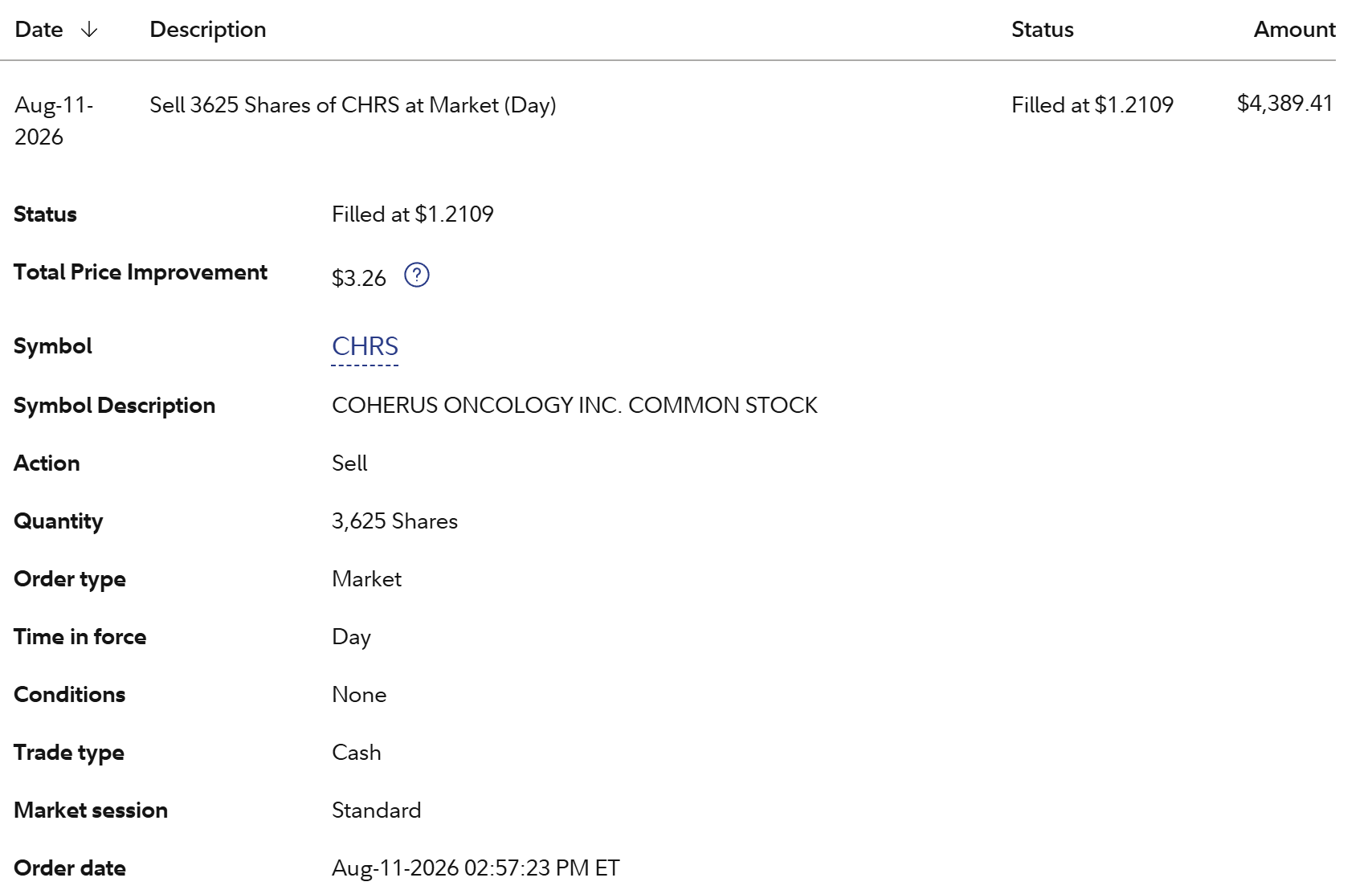
For transparency, these transaction receipts reflect the full position spread across three brokerage accounts.
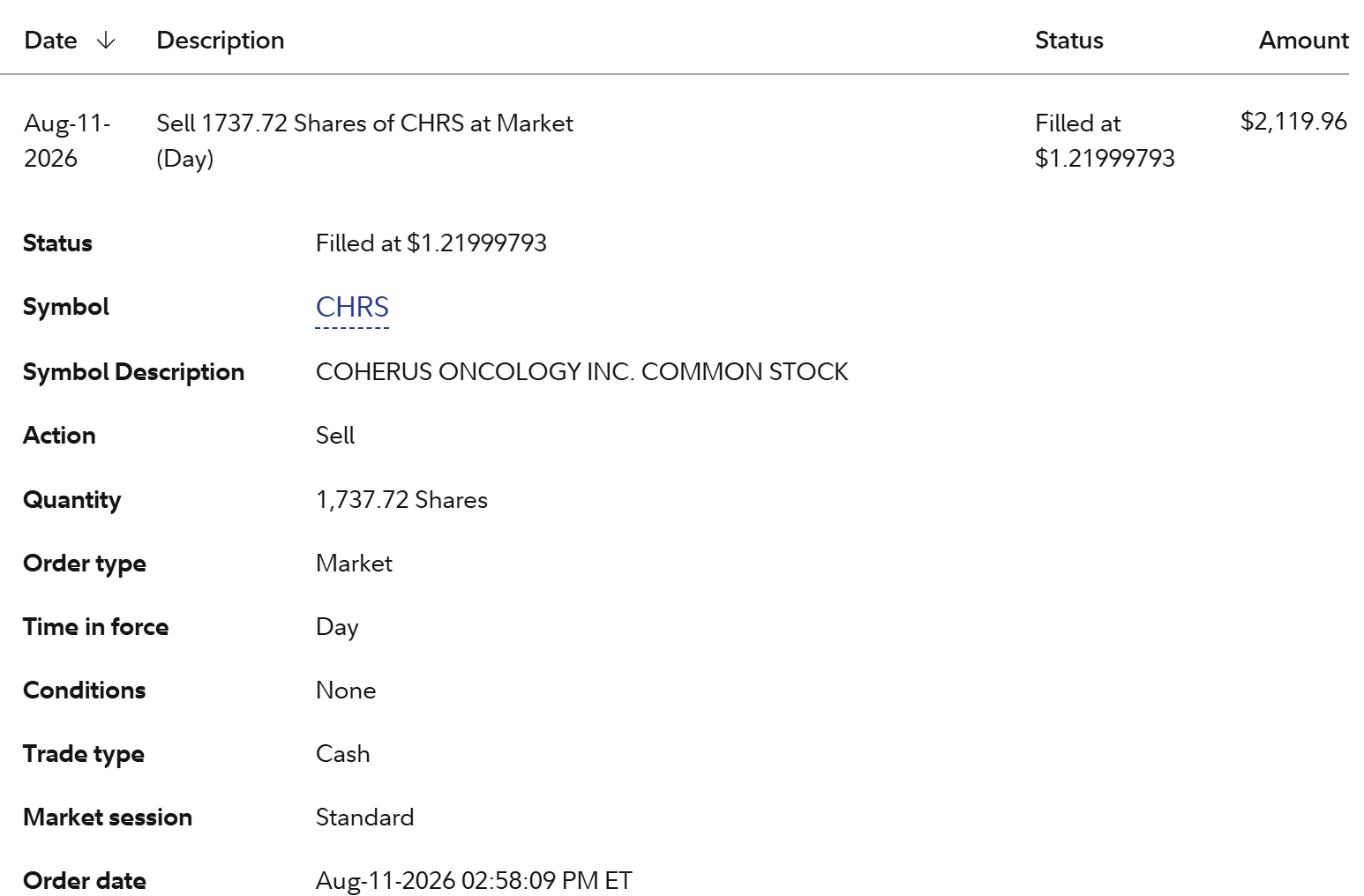
For transparency, these transaction receipts reflect the full position spread across three brokerage accounts.
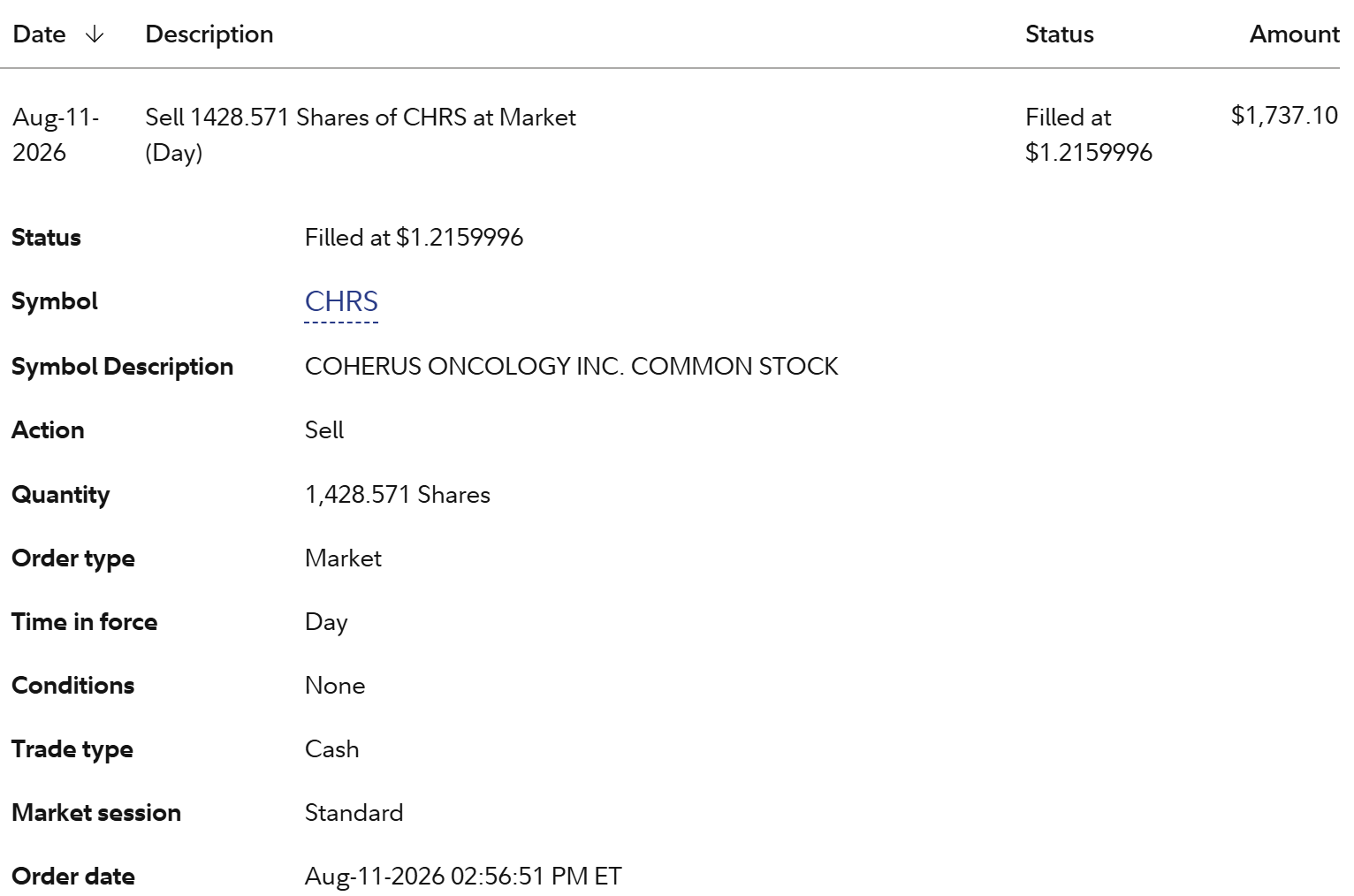
Further Reading
- August 11, 2026, real-time announcement on Discord
.svg)
.svg)
.svg)
.svg)



.avif)


.png)

.svg)
.svg)
.svg)