.svg)
-cropped.svg)
Want an email alert every time a Finch Trade goes live? Sign up in your profile.
The first-ever data readout for zovegalisib in vascular anomalies is scheduled for tomorrow morning – that's May 19, 2026. This will be a preliminary data readout from the phase 1/2 ReInspire study for about 20 patients through Week 12, which is the shortest duration of treatment that's generally acceptable to share data for these chronic conditions. Investors will need to settle in before more impactful data readouts through Week 48 and beyond come across the newswires.
Therefore, I'm not expecting fireworks, just simply continuing my long-term buildout of the position.
That said, the many rare diseases that fall under the broad umbrella of vascular anomalies could become a significant commercial opportunity for the asset. Although the nearest revenue opportunity for Relay Therapeutics remains 2L+ HR+/HER2- breast cancer, vascular anomalies could eventually generate more than three times the peak revenue of that late-line approval. Put another way, if zovegalisib was only approved in vascular anomalies, then it could become one of the top 50 bestselling drugs on the planet at its peak.
So um, what f*nching good are data from 20 patients through Week 12? These data will be super early, but can still provide valuable and potentially high-impact signals on the commercial opportunity.
The company's drug development strategy – more selective drugs lead to improved tolerability leads to improved efficacy – does take some time to marinate. All prior data readouts of a similar maturity were decent, but improved with time as Relay Therapeutics optimized dosing and inclusion / exclusion criteria. That will be true for ReInspire, too.
Remember, these data will include patients receiving different doses of zovegalisib, for different durations of treatment (the minimum is 12 weeks), and for the first time include much younger individuals. That's one important caveat for the data readout.
- Whereas the median patient in the phase 1/2 ReDiscover study in breast cancer was 60 years old, the May 2026 data readout from the phase 1/2 ReInspire study will include patients as young as 12 years old.
- Younger patients tend to respond better to treatment, are generally healthier, and in these indications haven't been bombarded with chemotherapy.
- Zovegalisib will also be evaluated in pediatric cohorts from 6 to 11 years old and 2 to 5 years old, but those will be disclosed in future data readouts.
Another important caveat is that zovegalisib monotherapy might have a surprisingly strong efficacy at Week 12. Relay Therapeutics has focused the asset's development on combinations because it's focused on the commercial opportunities in breast cancer, but it did share monotherapy data back in 2023.
Even better, the company shared swimlane data, which allow investors to see the duration of treatment plotted against each patient's best response. In other words, we can calculate a crude overall response rate (ORR) at Week 12 for breast cancer patients who received zovegalisib monotherapy. It's an imperfect signal for vascular anomalies, but perhaps it'll be directionally accurate.
- From the 2023 data readout in 2L HR+/HER2- breast cancer, four patients received zovegalisib monotherapy. By Week 12, one patient had a partial response, which results in an ORR of 25% (1/4). Not a very large patient population of course.
- The responder received 400 mg twice-daily fasted. Two other patients received 200 mg twice-daily fasted (one tumor grew, one remained stable), while the final patient received 200 mg once-daily fasted (tumor grew).
- The ReInspire study is using the new twice-daily fed dosing, which improves the availability of zovegalisib. The May 2026 data readout will include patients who received either 400 mg, 300 mg, or 100 mg.
An ORR of 25% at Week 12 may not sound like much, but it would lead the competitive landscape if replicated in vascular anomalies.
- Novartis evaluated alpelisib in the EPIK-P2 study in individuals with PI3K-related overgrowth syndromes (PROS). At Week 16, only 11% of adults and 9% of pediatric patients had a partial response. By the time the study concluded, only 17% of adults and 23% of pediatric patients achieved a partial response at any time point.
- The highest-ever ORR in vascular anomalies was 33% for patients treated with serebelisib for at least 24 weeks.
- In preclinical models of PROS, zovegalisib led to 5x to 10x greater tumor reductions than alpelisib. Relay Therapeutics has enjoyed relatively smooth translation from preclinical to clinical development.
Vascular anomalies aren't the same as breast cancer. For one thing, Relay Therapeutics is (obviously) focused on vascular anomalies that are primarily driven by mutations in PI3K-alpha, whereas breast tumors are more co-dependent on other mutations. For another, treatment will be chronic and potentially life-long, perhaps including reduced doses for long-term maintenance therapy.
At any rate, Relay Therapeutics has been quietly building buzz for zovegalisib in vascular anomalies with clinical webinars and trademarking the term "VAntage" as an early brick in the commercial infrastructure. If the early data are impressive enough, then the company could potentially piggyback on its vast safety database for zovegalisib in breast cancer to kick off its first pivotal study in vascular anomalies in late 2027 or early 2028.
It'll be expensive.
The Transaction
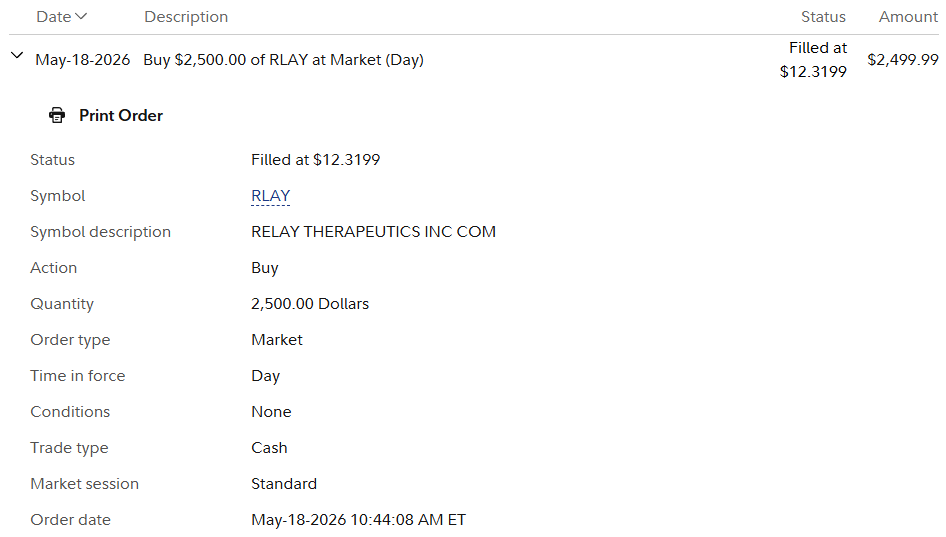
Relay Therapeutics is considered a Future Compounder position. I purchased 202.92 shares at $12.32 per share on May 18, 2026. The total transaction value was $2,500.
Outperformance Scenarios
Investing in individual stocks can be reduced to a simple question: "If I invest $1 in this individual stock at this price, will it outperform an equal passive investment in the S&P 500 at this level?" If you keep emotions and expectations in check, then you might be surprised to learn you don't need to swing for the fences.
Here's how shares of Relay Therapeutics will need to perform for the money invested in this Finch Trade to outperform passive investing in the S&P 500 in the next five years.

Assumptions:
- The S&P 500 index gains 10% per year with dividends included – its historical average since 1990.
- S&P 500 closing level at time of purchase on May 18, 2026 = 7,403
- Relay Therapeutics purchase price on May 18, 2026 = $12.32 per share
Margin of Safety & Allocation
Relay Therapeutics is considered a Future Compounder position. The estimated fair valuation based on my current model is below:
- Market close May 18: $12.10 per share
- Modeled Fair Valuation: $17.68 per share
Relay Therapeutics reported 191.586 million shares outstanding as of May 1, 2026. The modeled fair valuation above assumes 237.5 million shares outstanding, which accounts for all expected dilution through the initial commercial launch of zovegalisib.
.svg)
.svg)
.svg)
.svg)



.avif)


.png)

.svg)
.svg)
.svg)