Relay Therapeutics should end June 2026 with about $894 million in cash. Management has made it clear the intention is to remain an independent company, get zovegalisib across the finish line, and maximize economic rights to the rest of its pipeline. Ironically, in biotech, controlling your own destiny and not dangling the acquisition carrot in front of investors subdues your valuation premium. Fine with me!
What will the company do with all that cash?
Well, it needs to fund its first pivotal study for a zovegalisib triplet in the 1L endocrine sensitive population for HR+/HER2- breast cancer. It needs to collect more data for zovegalisib in vascular anomalies to potentially earn an accelerated approval. Then it needs to start investing in commercial infrastructure for both breast cancer and vascular anomalies. Oh, and it needs to fund the first part of the phase 1/2 study of RLY-8161 (NRAS inhibitor), which will be relatively expensive to continue developing due to the diverse tumor types driven by NRAS mutations.
There are some open questions lingering, too. What are the plans for the Fabry disease candidate, which has above-average licensing potential? Is Relay Therapeutics also developing a novel PI3K-alpha inhibitor that can cross the blood-brain barrier to treat cerebral cavernous malformations (CCM)? Will is resurrect the CDK2 inhibitor RLY-2139 for next-generation triplets in breast cancer? Speaking of, will it explore a zovegalisib triplet with atirmociclib in 2L+ HR+/HER2- breast cancer? If so, how does that impact the ongoing pivotal ReDiscover-2 study for the zovegalisib doublet with fulvestrant?
As you can see, staying independent sure gets expensive quickly. Relay Therapeutics has been pretty good at prioritizing strategic moves in recent years. Let's hope it doesn't lose focus until cash flows are on the horizon.

Relay Therapeutics (Nasdaq: RLAY) is a rare full-stack precommercial drug developer. It offers investors one of the most frictionless combinations of drug discovery, drug development, and commercial strategy. The drug discovery engine, Dynamo, combines experimental and computational data in an iterative design, build, test, learn (DBTL) cycle. Whereas most drugs today are discovered using structure-based drug design (SBDD) that requires accurate 3D structures of druggable proteins, the company is pioneering motion-based drug design (MBDD) that simulates how 3D protein structures change over time. Protein motion can uncover novel allosteric and cryptic binding pockets, which can be used to discover highly-selective molecules for precision medicine applications.
Meanwhile, the company is one of the first model-informed drug development (MIDD) and quantitative systems pharmacology (QSP) native drug developers. It designs unusually robust early-stage clinical trials for a precommercial drug developer. Capturing detailed data from human patients gives Relay Therapeutics confidence to both pursue aggressive study designs and position assets to quickly realize commercial opportunities.
The protien motion pioneer is one of the most promising emerging drug developers in the United States.
An estimated 14% of all solid tumors harbor a PI3K-alpha mutation, second only to KRAS. Relay Therapeutics used a combination of experimental and computational tools to solve the first full-length structure of the PI3K-alpha protein, including both wild-type and mutant forms. That led to the discovery of zovegalisib as the first selective, pan-mutant, allosteric inhibitor of PI3K-alpha. The molecule spares other PI3K isoforms that trigger common side effects and has acceptable on-target tolerability for hyperglycemia. The pivotal ReDiscover-2 study in CDK inhibitor experienced HR+/HER2- breast cancer is expected to conclude in mid-2028.
Full research deep dive coming soon.
Full research deep dive coming soon.
Mutations in PI3K-alpha can cause benign, non-cancerous tumors in various overgrowth syndromes collectively called vascular anomalies (VA). The favorable efficacy and tolerability profiles of zovegalisib suggest the molecule has significant potential as a chronic treatment for these conditions, although doses are likely to be lower than those used in oncology indications. There are an estimated 170,000 patients in the United States with PI3K-alpha driven VAs. Relay Therapeutics is initially focusing on an estimated patient population of 25,000 individuals affected by PI3K-related overgrowth syndrome (PROS), lymphatic malformations (LM), and venous malformations (VeM).
Full research deep dive coming soon.
Full research deep dive coming soon.
An estimated 14% of all solid tumors harbor a PI3K-alpha mutation, second only to KRAS. Relay Therapeutics used a combination of experimental and computational tools to solve the first full-length structure of the PI3K-alpha protein, including both wild-type and mutant forms. That led to the discovery of zovegalisib as the first selective, pan-mutant, allosteric inhibitor of PI3K-alpha. The molecule spares other PI3K isoforms that trigger common side effects and has acceptable on-target tolerability for hyperglycemia. The company is expected to provide an update on the pivotal development plan in CDK inhibitor naive HR+/HER2- breast cancer by the end of 2026.
Full research deep dive coming soon.
Full research deep dive coming soon.
Whereas NRAS-driven cancers are typically treated with pan-RAS molecules or by targeting downstream pathways with pan-RAF, MEK, or ERK inhibitors, these agents have unfavorable tolerability profiles due to the importance of RAS family proteins. Relay Therapeutics used protein motion to discover novel allosteric, cryptic pockets unique to mutant NRAS proteins. As such, RLY-8161 is the first NRAS-selective molecule in the global industry pipeline. The full commercial opportunity is dispersed across many types of solid tumors impacting an estimated 29,000 U.S. patients, but initial development may focus on colon cancer (6,500 U.S. patients), melanoma (4,300 U.S. patients), and non-small cell lung cancer (NSCLC) (2,100 U.S. patients).
Full research deep dive coming soon.
Full research deep dive coming soon.
This unnamed preclinical asset is a non-inhibitory chaperone of mutant alpha-galactosidase A (α-Gal A) enzymes. Mutant α-Gal A loses its ability to break down globotriaosylceramide (Gb3). Fabry disease is caused by the accumulation of Gb3 in organs throughout the body. However, there are hundreds of known mutations, which has thwarted attempts to develop effective treatments. This asset works by binding to and bending mutant α-Gal A enzymes into functional enzymes with more activity. As a non-inhibitory chaperone, it could be effective against dozens of common mutants and compatible with enzyme replacement therapy (ERT).
Full research deep dive coming soon.
Full research deep dive coming soon.
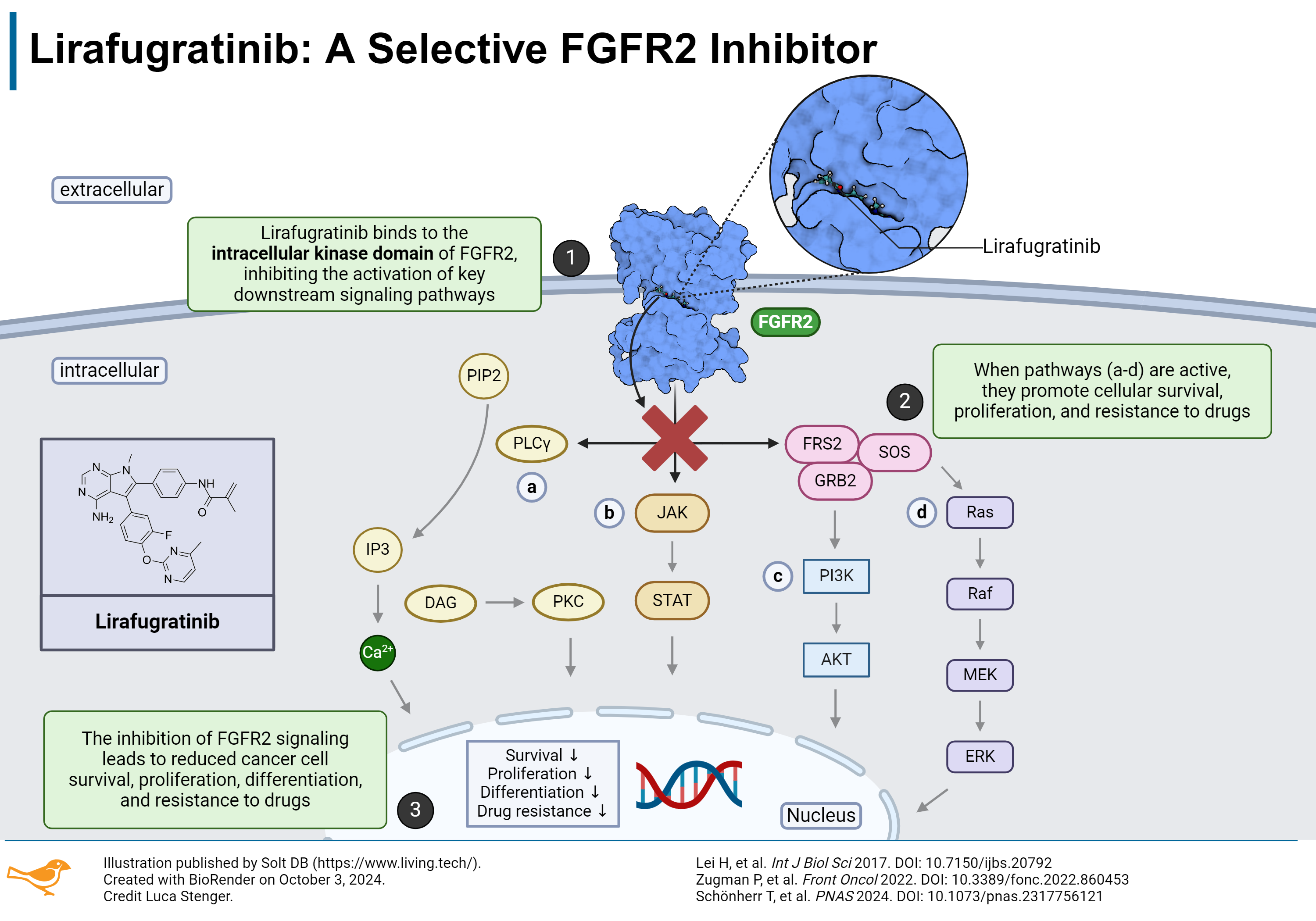
Lirafugratinib is a highly-selective small molecule inhibitor of FGFR2, which is mutated, amplified, or fused in specific types of solid tumors. Relay Therapeutics discovered the molecule by simulating protein motion of related FGFR proteins to find a unique allosteric pocket on the FGFR2 protein. The initial indication in cholangiocarcinoma (CCA) is a relatively rare, aggressive cancer. A slightly broader tumor-agnostic opportunity could be accessed pending the results of an additional pivotal study.
Full, global rights to lirafugratinib were outlicensed to Elevar Therapeutics in December 2024. Elevar Therapeutics is responsible for all development, regulatory, and commercial activities in all indications. As of December 31, 2025, Relay Therapeutics is eligible to receive $488 million in remaining future development, regulatory, and commercial milestone payments; plus tiered royalties up to the low double-digits on global sales.
Remember that most commercial milestone payments are backweighted to sales targets that are well into the future and are unlikely to be achieved.
Full research deep dive coming soon.
Full, global rights to lirafugratinib were outlicensed to Elevar Therapeutics in December 2024. Elevar Therapeutics is responsible for all development, regulatory, and commercial activities in all indications. As of December 31, 2025, Relay Therapeutics is eligible to receive $488 million in remaining future development, regulatory, and commercial milestone payments; plus tiered royalties up to the low double-digits on global sales.
Remember that most commercial milestone payments are backweighted to sales targets that are well into the future and are unlikely to be achieved.
Full research deep dive coming soon.
Lirafugratinib is a highly-selective small molecule inhibitor of FGFR2, which is mutated, amplified, or fused in specific types of solid tumors. Relay Therapeutics discovered the molecule by simulating protein motion of related FGFR proteins to find a unique allosteric pocket on the FGFR2 protein. The initial indication in cholangiocarcinoma (CCA) is a relatively rare, aggressive cancer. A slightly broader tumor-agnostic opportunity could be accessed pending the results of an additional pivotal study.
Full, global rights to lirafugratinib were outlicensed to Elevar Therapeutics in December 2024. Elevar Therapeutics is responsible for all development, regulatory, and commercial activities in all indications. As of December 31, 2025, Relay Therapeutics is eligible to receive $488 million in remaining future development, regulatory, and commercial milestone payments; plus tiered royalties up to the low double-digits on global sales.
Remember that most commercial milestone payments are backweighted to sales targets that are well into the future and are unlikely to be achieved.
Full research deep dive coming soon.
Full, global rights to lirafugratinib were outlicensed to Elevar Therapeutics in December 2024. Elevar Therapeutics is responsible for all development, regulatory, and commercial activities in all indications. As of December 31, 2025, Relay Therapeutics is eligible to receive $488 million in remaining future development, regulatory, and commercial milestone payments; plus tiered royalties up to the low double-digits on global sales.
Remember that most commercial milestone payments are backweighted to sales targets that are well into the future and are unlikely to be achieved.
Full research deep dive coming soon.
.svg)
.svg)
.svg)
.svg)
-cropped.svg)

.svg)
.svg)
.svg)
.svg)


.svg)


